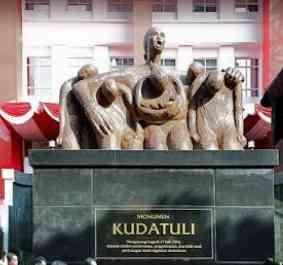
Memory and Political Realism: An Alternative Perspective on the Kudatuli Monument
In his essay in Jacobin, titled "Indonesia Still Hasn't Come to Terms With Suharto's Crimes," Michael G. Vann offers a sharp critique of the inauguration of a commemorative statue for the 27 July 1996 incident (Kudatuli) at the headquarters of the PDI-P. Vann views the monument as a partisan representation that fails to advance the agenda of transitional justice, while simultaneously serving as a marker of Indonesia's historical amnesia concerning the crimes of the New Order. However, the normative approach proposed by Vann is constrained by an idealistic perspective that tends to leave a significant analytical gap. Vann overlooks one important element of the sociology of power in Indonesia: the monumentalization of past political phases and crises is rarely intended to pursue objective historical truth. Rather, it can be understood as a form of symbolic capitalization that is continuously managed and reproduced. A realist reading rooted in local political dynamics instead suggests that the establishment of the monument, together with all the ambiguities surrounding the resolution of the case, should not necessarily be interpreted as a "failure of memory," as Vann assumes. On the contrary, in my view, it represents a conventional, rational, and arguably strategic instrument of power consolidation for the PDI-P, at least within the context of internal party education.
In my view, the Kudatuli Monument was not established primarily to satisfy the historical thirst of the broader public per se, but emerged from the internal perspective of the PDI-P itself. The statue may function simultaneously as a marker and as an absolute consecration of the notion that the moment it commemorates was central and irreplaceable, effectively becoming a kind of raison d'tre for the party itself.
Vann's criticism, which assumes that the PDI-P should pursue some form of closure regarding the Kudatuli incident and directly associates it with the repressive architecture of the New Order era, also strikes me as biased and misleading, particularly when viewed in the context of Indonesia as a nation that continues to strive to move forward with a positive and constructive tone and spirit.
Nevertheless, if we were to force a political calculation onto Vann's perspective, closure itself may not be particularly important. Perhaps, from a political standpoint, formally resolving the case through legal mechanisms would not generate benefits commensurate with those obtained by allowing the episode to remain embedded within the public narrative. This is my assumption. By allowing it to remain within the realm of a struggle myth, the party may obtain a far greater gain: a unifying ideology that can continually be reproduced to sustain and reinforce cadre militancy without a predetermined temporal limit.
I understand Vann's interpretation of the Kudatuli Monument as a commemorative site for victims of state violence, justified almost play by play through a narrative whose validity remains contested, as reflecting a fundamental bias. The narrative that has emerged is not a form of popular claim that developed organically and inclusively, but rather an exclusive political articulation by a single party. By transferring the memory of the 1996 riots into the private institutional space of the organization, the inauguration of the monument effectively constitutes a privatization of history imbued with a strong tendency toward politicization. Rather than serving as a vehicle for the enforcement of public rights or the pursuit of legal truth for society at large, the monument is presented as an instrument for constructing a partisan historical narrative, deliberately managed to preserve a struggle myth and legitimize the position of the party's political elite.
Conclusion
Expecting a political party to dismantle the history of its own suffering in pursuit of an academic or legal acknowledgment that ultimately provides little practical benefit is an absurd proposition in practical politics. The Kudatuli Monument, in essence, is not a monument about the past. It is a monument about the present and the future: a manifesto of resilience, a measure of cadre loyalty, and a symbolic boundary distinguishing the party from other political entities. Understanding this means recognizing that, in politics, a continuously living political moment can have far greater impact. And this has little, if anything, to do with the issue alleged by the author.
Kolom Komentar Pembaca
Tuliskan tanggapan Anda mengenai berita ini: